Student Visa Interview Questions 2026: How to Answer the 5 Questions Every Bangladeshi Student Gets Asked
5 November 2026 · Updated 9 November 2026
Most student visa and university credibility interviews focus on five things: your course, your university, why you’re studying abroad, how you’ll pay, and your plans after graduation.
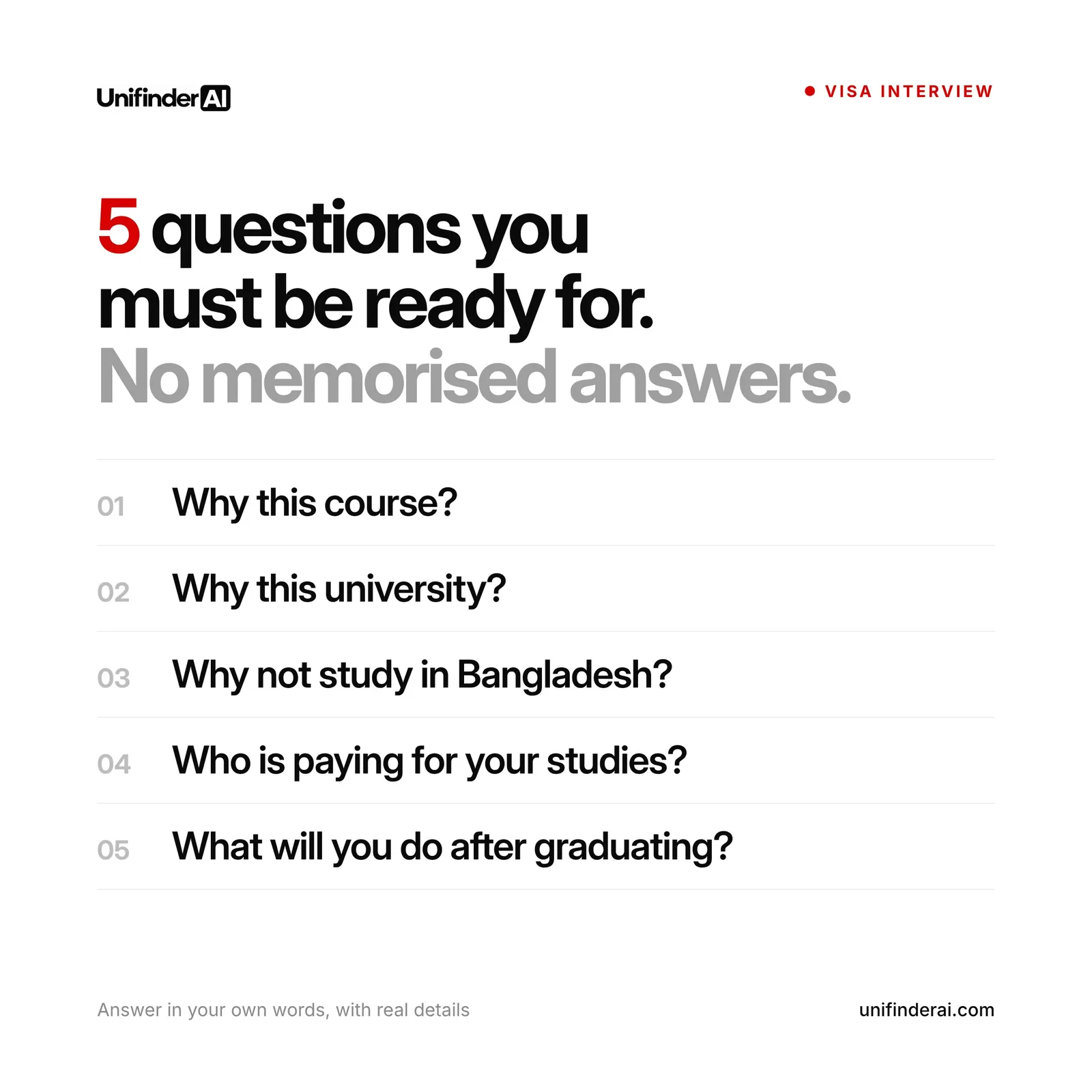
- "Why did you choose this course?"
What the officer is checking: that your course makes sense for you. It should follow logically from what you studied or did before, and lead to a clear career. How to answer: • Start with your background: your degree, your job or a project you did. • Name two or three modules from the course and say what you will learn from them. • Link the course to a specific career goal. Sample answer: "I studied Civil Engineering at a public university in Bangladesh and worked for two years on road projects in Dhaka. I saw how traffic planning causes delays and cost overruns. The MSc in Transport Planning includes modules in Traffic Modelling and Sustainable Transport Systems, which give me the skills I don't have yet. I want to work as a transport planner on city projects back home." Mistakes to avoid: • Choosing a course with no link to your past study, without explaining why you are changing field. • Saying "it is a good course" or "it has good job opportunities" with no detail. • Not knowing the names of any modules.
- "Why did you choose this university?"
What the officer is checking: that you researched your university and chose it for real reasons, not because an agent picked it or it was the only offer. How to answer: • Mention something specific: a module, a research centre, a lab, an industry partnership or a professor's work. • Say why it matters for your goal. • If you compared other universities, say why this one fits best. Sample answer: "I compared three universities. I chose this one because its transport research centre works directly with city councils, and the course includes a live project with an industry partner. That practical experience is exactly what I need for my career plan." Mistakes to avoid: • Only saying "it is highly ranked" or "it has a good reputation." • Saying "my agent suggested it" or "my friend studies there." • Not knowing the city or campus where you will live.
- "Why don't you study this in Bangladesh?"
What the officer is checking: that studying abroad adds real value, and that you are not using the student visa just to leave the country. How to answer: • Be respectful about education in Bangladesh. Never criticise it. • Name what this course offers that is hard to find at home: a specialisation, equipment, research, industry links or international recognition. • Explain how that value helps your career in Bangladesh. Sample answer: "Universities in Bangladesh offer strong civil engineering degrees, but a specialised master's in transport modelling with industry software and live projects isn't widely available yet. This course gives me those skills, and Bangladesh's metro and highway projects need planners with this training." Mistakes to avoid: • Saying "education in Bangladesh is bad" or "there is no future in Bangladesh." • Saying you want to "settle abroad" or "get PR." • Giving a reason that applies to any country, such as "better quality of life."
- "Who is paying for your studies?"
What the officer is checking: that the money is real, belongs to you or your sponsor, and will really be available for your studies. How to answer: • Name your sponsor and your relationship to them (for example, your father). • Say what they do and how they earn: salary, business, farming income, rent. • Explain how the money was saved, and know the total amount and your first-year costs. • Make sure every answer matches your bank statement and documents. Sample answer: "My father is paying. He has run a garments accessories business in Narayanganj for 15 years. The funds come from his business income and a fixed deposit he has held since 2022. My first-year tuition is £18,000 and I have shown living costs for nine months." Documents to have ready: bank statements, a sponsor letter, proof of income (salary slips, trade licence and tax returns, or land and rent papers), and proof of the relationship (birth certificate). For the UK specifically: funds must be held for at least 28 days in a row before you apply. From 30 November 2026 you must show £1,570 a month in London or £1,203 a month elsewhere, for up to 9 months (GOV.UK). Mistakes to avoid: • Not knowing how much money is in the account or where it came from. • A large deposit just before applying with no clear source. • Saying you will work part-time to pay your tuition.
- "What will you do after you graduate?"
What the officer is checking: that you have a realistic career plan, and that your course is a step towards it. How to answer: • Name a specific role and the type of employer, sector or project. • Explain how your new skills help you get there. • Mention ties to Bangladesh, such as family, a job you could return to, or a growing sector at home. • If you plan to use the UK Graduate visa for work experience first, say so honestly and explain how it fits your plan. Sample answer: "I want to work as a transport planner with a consultancy on Dhaka's metro and road projects. My previous employer has said I could rejoin in a senior role after my master's. Some work experience abroad first would help, but my long-term career is in Bangladesh." Mistakes to avoid: • "I haven't decided yet." • A plan with no link to your course. • Saying your main goal is to settle abroad or bring your family over. Tips for the interview day • Know your own file. Re-read your SOP, CAS or I-20, offer letter and bank statement. Your answers must match them. • Speak naturally. Short, clear answers in your own words beat long memorised speeches. • Be honest. If you don't know something, say so calmly. A false answer is far worse than "I'm not sure." • Practise out loud. Do a mock interview with a friend or record yourself on your phone. • Check your setup. For online interviews, test your camera, internet and a quiet room the day before. • Keep documents ready. Have your passport, offer letter, financial documents and English test results close by. Frequently asked questions What questions are asked in a student visa interview? The most common are: why this course, why this university, why not study in your home country, who is paying, and what you will do after graduating. Officers may also ask about your English test, your SOP and your family. How long is a UK credibility interview? It varies by university and case. Many are short, often 10 to 20 minutes, but prepare for follow-up questions on any answer. Should I memorise my visa interview answers? No. Prepare the facts, not a script. Interviewers notice memorised answers and may ask unexpected follow-ups to test them. Can I say I want to work in the UK after graduating? You can mention the Graduate visa honestly, but show a clear long-term career plan that your course supports. What if I make a mistake in my answer? Stay calm and correct it politely: "Sorry, let me clarify." Honesty matters more than a perfect answer. Prepare with UnifinderAI Choosing the right course and university makes every one of these answers easier. Our AI counsellor helps you shortlist universities that fit your background, budget and career goals. Start your plan at unifinderai.com. Sources • GOV.UK: Student visa, money you need • GOV.UK: Statement of changes to the Immigration Rules, HC 584